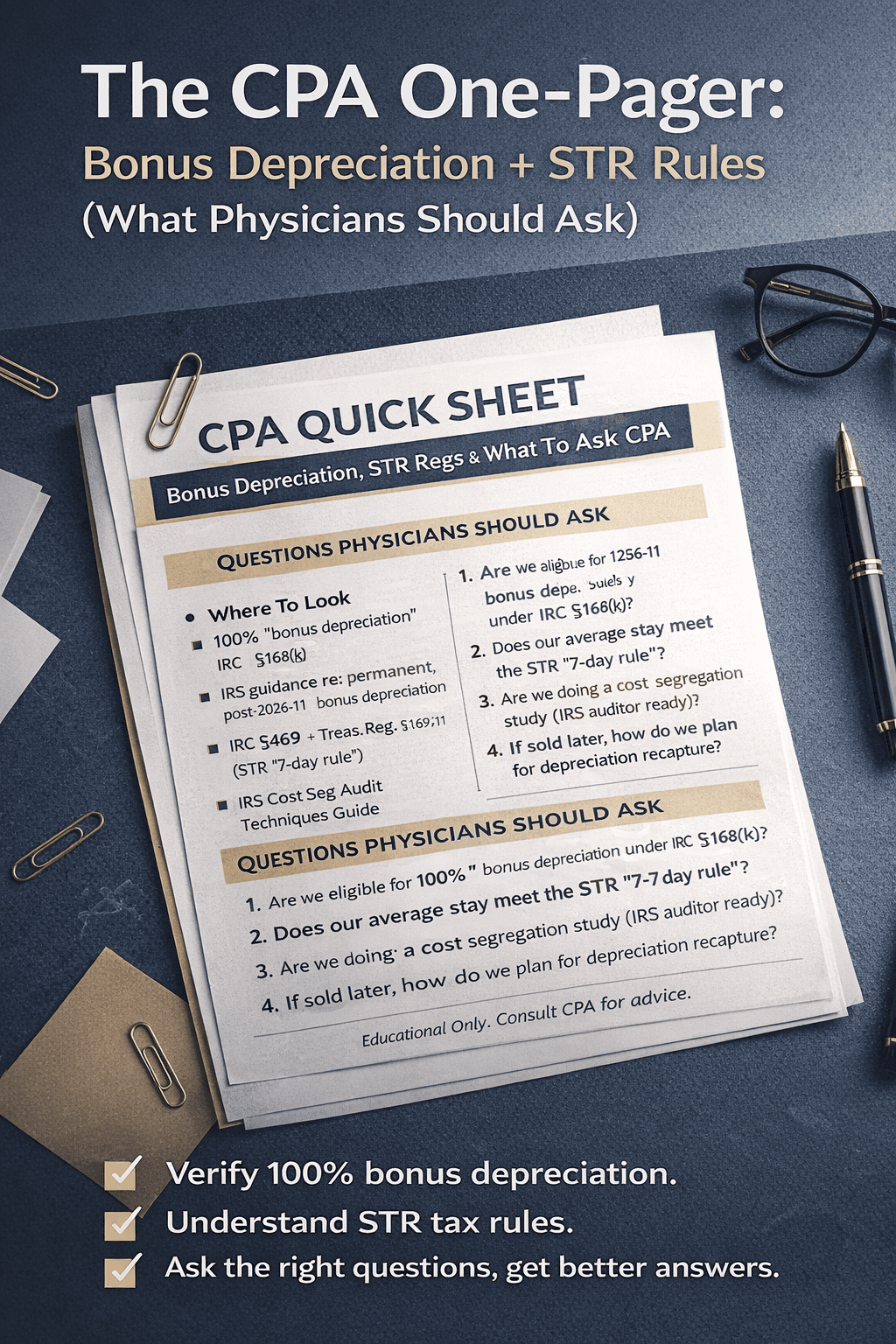
What to ask your CPA: Bonus Depreciation + STR Rules
If your CPA “doesn’t do STR stuff,” send them this
recommended post

How One Short-Term Rental Saved Me Over $100K in Taxes

Cost Segregation 101: Accelerating Tax Savings Through Real Estate

How Material Participation Can Save You Six Figures in Taxes — Even Without Real Estate Professional Status
Bonus Depreciation Back at 100%: Why the One Big Beautiful Bill Changes Everything

Real Estate for Physicians: A Smarter Wealth Strategy

Join the Passive Investor Waitlist
Who this is for
If you’re a high-income W-2 or 1099 professional and you’re using real estate (especially STRs) for tax strategy, you don’t need a “creative” CPA. You need a CPA who will read the law, document the position, and file it cleanly.
This page is the one-pager you can send them.
1) Where to look (primary authority)
IRC §168(k) — “additional first-year depreciation deduction” (bonus depreciation).
IRS guidance after the One Big Beautiful Bill Act (OBBBA) + Notice 2026-11 — confirms permanent 100% bonus depreciation and transition rules.
IRS Cost Segregation Audit Techniques Guide (ATG) — what the IRS expects a defensible cost segregation study to look like.
Passive activity framework: IRC §469
STR “7-day rule”: Treas. Reg. §1.469-1T(e)(3)(ii)(A) — average customer use ≤7 days means it is not a rental activity for §469 purposes.
Material participation tests: Treas. Reg. §1.469-5T — the rules used to decide whether the activity is non-passive.
(Links to every source are at the bottom of this post.)
2) The questions you should ask your CPA
Use these exactly. If your CPA can answer these quickly (and correctly), you’re in good hands.
A. Bonus depreciation (100% under OBBBA)
Under current law and IRS guidance, are we eligible for 100% bonus depreciation under §168(k) for this tax year?
What are our acquired date and placed-in-service date, and does that satisfy the OBBBA timing rules?
Are there any transition elections we should consider (for example, electing a lower percentage in the first affected year)?
Are we electing out of bonus depreciation for any property class? If yes, why?
Which form(s) and lines are we using to claim this (typically Form 4562), and what support are we attaching?
B. Cost segregation (the “multiplier” for real estate)
6) Are we doing a cost segregation study that would be considered a “quality study” under the IRS Cost Seg ATG (methodology, asset detail, class lives, support/authority)?
7) Roughly what portion of the property is expected to be reclassified into 5-, 7-, and 15-year property that could be eligible for bonus depreciation (versus 27.5-year building and non-depreciable land)?
8) If we’re doing cost seg after the fact, do we need to consider an accounting method change approach (and what is your preferred workflow)?
C. STR rules (the part many CPAs miss)
9) Does our property meet the ≤7-day average stay threshold under Reg. §1.469-1T(e)(3)(ii)(A) (or the ≤30-day rule with significant services)?
10) If yes, are we treating the activity as not a rental activity under §469 — and then analyzing whether it is non-passive based on material participation?
11) Which material participation test under Reg. §1.469-5T are we relying on (500 hours, 100 hours + more than anyone else, substantially all, etc.)?
12) What documentation do you want me to keep (calendar, platform reports, messaging logs, turnover coordination, supplies, pricing changes, guest issues)?
D. Big-picture sanity checks (the stuff that matters later)
13) Does our state conform to federal bonus depreciation, or are we going to have a federal/state mismatch?
14) If we sell later, what is the depreciation recapture exposure likely to look like, and how should we plan for it?
15) If I don’t qualify via STR non-rental rules, are we relying on Real Estate Professional rules under §469(c)(7) (possibly via spouse), and do we need to consider the grouping/election strategy?
The “tell” that your CPA knows this (or doesn’t)
A CPA who knows this world will immediately talk about:
§168(k) + the new IRS guidance (and timing)
placed-in-service documentation
cost segregation quality expectations (ATG)
§469 + 7-day rule + material participation tests
state conformity and recapture planning
If the response is: “I don’t do STR stuff,” that’s not a disqualifier — as long as they’re willing to read, document, and implement the actual code/reg guidance above.
Educational disclaimer
This is educational information, not tax advice. Your CPA should validate facts, elections, filing positions, and state conformity for your specific situation.
IRS Newsroom: Treasury/IRS guidance re: bonus depreciation + OBBBA
https://www.irs.gov/newsroom/treasury-irs-issue-guidance-on-the-additional-first-year-depreciation-deduction-amended-as-part-of-the-one-big-beautiful-bill
IRS: One Big Beautiful Bill provisions page
https://www.irs.gov/newsroom/one-big-beautiful-bill-provisions
IRS Notice 2026-11 (PDF)
https://www.irs.gov/pub/irs-drop/n-26-11.pdf
IRC §168 (Cornell Law) — includes §168(k)
https://www.law.cornell.edu/uscode/text/26/168
IRS Cost Segregation Audit Techniques Guide (PDF)
https://www.irs.gov/pub/irs-pdf/p5653.pdf
IRC §469 (Cornell Law) — passive activity framework
https://www.law.cornell.edu/uscode/text/26/469
Treas. Reg. §1.469-1T (Cornell Law) — includes the 7-day rule location
https://www.law.cornell.edu/cfr/text/26/1.469-1T
Treas. Reg. §1.469-5T (Cornell Law) — material participation tests
https://www.law.cornell.edu/cfr/text/26/1.469-5T
IRS Instructions for Form 4562
https://www.irs.gov/instructions/i4562